What Size Storage Unit Do I Really Need? How to Avoid Renting One That’s Too Big
Most people who rent a storage unit for the first time make the same mistake: they go for a “better safe than sorry” size that is much bigger than they actually need. At first this feels like a safe choice, but in reality it means you pay extra every single month for space you never use. With a bit of planning and some expert help, a much smaller unit is often more than enough.
In this article, we’ll show you how to estimate your needs realistically, what 1–2, 3–4, 5–7 and 8+ m² look like in practice, when a larger unit is really justified, and when it’s simply a waste of money. At the end, you’ll find a quick form where our team can help you choose the ideal size for your situation – with no obligation.
Why Do People Choose a Storage Unit That’s Too Big?
At first, “I’d rather have more space than not enough” sounds logical. In practice, though, this cautious mindset often only results in a higher monthly bill – for no good reason. Here’s what usually happens.
One of the biggest problems is that most of us have no real feel for square metres. A 4 or 6 m² unit looks fine on paper, but it’s hard to imagine how many boxes, pieces of furniture or household items this actually means. Because of that, people tend to say a higher number “just to be safe”.
Another typical issue is that people only think in terms of floor area and don’t use the height of the unit. In their minds, the storage unit looks like a room where everything is “spread out”: sofa, wardrobe, a few boxes – and it seems full already. In reality, if you pack properly in boxes and use the vertical space, the same amount of stuff can easily fit into a smaller unit with a higher ceiling.
On top of that, moving, renovating or changing homes is stressful and chaotic. In this state it feels easier to overestimate than to think through the details. That’s completely understandable, but with an experienced colleague asking you a few targeted questions, it often turns out you can safely choose a smaller unit – and everything will still fit in comfortably.
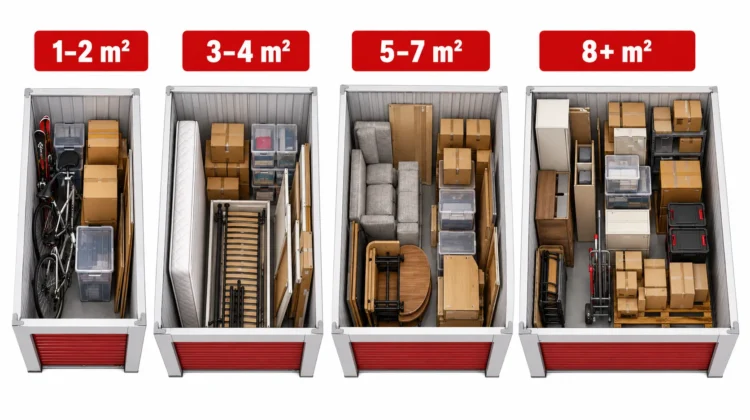
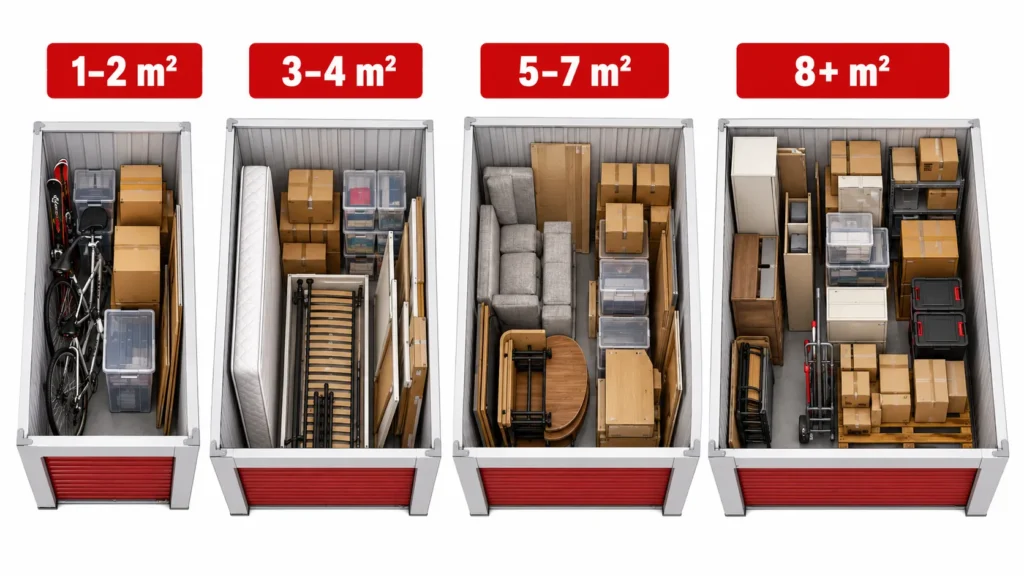
What Does 1–8 m² Look Like in Real Life?
To choose the right size, you need more than just numbers – you need concrete examples. Use the guidelines below to see where you fall on the scale.
1–2 m²: Seasonal Items and Smaller Stuff
This size sounds tiny, but with conscious packing, you’d be surprised how much it can hold.
It’s ideal if you want to store things like:
-
sports equipment (ski gear, bicycle, skateboard, hiking gear)
-
seasonal items: Christmas decorations, off‑season clothes and shoes, kids’ stuff
-
a few small pieces of furniture (chairs, small table, shelves) plus several boxes
With good boxing, 1–2 m² can comfortably hold the contents of a smaller wardrobe. If you’re not emptying a whole flat, just want to declutter your home a bit, this size is often more than enough.
3–4 m²: A 1–2 Room Flat – Disassembled
This size typically works for people who want to store the furniture and boxes from a studio or 1–2 room flat and are willing to disassemble the larger pieces.
You can usually fit, for example:
-
a bed frame taken apart, mattress standing on its side
-
one or two wardrobes or chests of drawers in flat‑pack form
-
a sofa stored vertically or taken apart into sections
-
dozens of boxes with household items, clothes and kitchenware
Many people automatically assume they need 5–7 m² for this amount of stuff, but with proper packing, 3–4 m² is often enough. This is where “overshooting” the size is most common – and where one good piece of advice can save you a noticeable amount of money every month.
5–7 m²: A 2–3 Room Flat With Larger Furniture
If you have several large, non‑disassemblable pieces of furniture or you’re packing up a full 2–3 room flat, 5–7 m² can be a realistic choice.
You might fit things like:
-
a bigger corner sofa that can’t be fully taken apart
-
several large wardrobes or built‑in closets, partly or fully assembled
-
a dining table, chairs, sideboards, bookcases
-
lots of boxes (books, kitchen items, decorations, toys)
Even in this size range, how you pack makes a huge difference. The same belongings, dumped in loosely, can easily require 8 m², while stacked neatly along the walls and using the full height may fit into 5–6 m².
8+ m²: Large Households or Business Inventory
Above 8 m² we usually see two situations: either the entire contents of a large family house go into storage, or the unit is used for business purposes.
Typical scenarios:
-
many large furniture pieces that can’t be taken apart (big wardrobes, antique items, piano)
-
a lot of bulky items: machinery, tools, scaffolding, sports equipment
-
frequent access: you walk in and out often and need space to move between your boxes
People often place themselves in this category by default (“let’s take a big one, just in case”), but in reality, this size is rarely necessary. With a few good questions and some experience, it often turns out that a much smaller unit would still be perfectly adequate.
How Can More Stuff Fit Into a Smaller Storage Unit?
The right unit size doesn’t only depend on how much you have, but also on how you pack it. With smart organisation, the same amount of belongings can often “shrink” by a whole size category – which means immediate savings.
Take Apart Whatever You Can
The biggest space‑killers are large, rigid pieces of furniture. The more items you can disassemble, the more compactly you can store them.
It’s worth:
-
taking beds, wardrobes and shelving units apart right down to the screws
-
packing doors and shelves separately and standing them against the wall
-
removing table legs and storing the tabletop upright
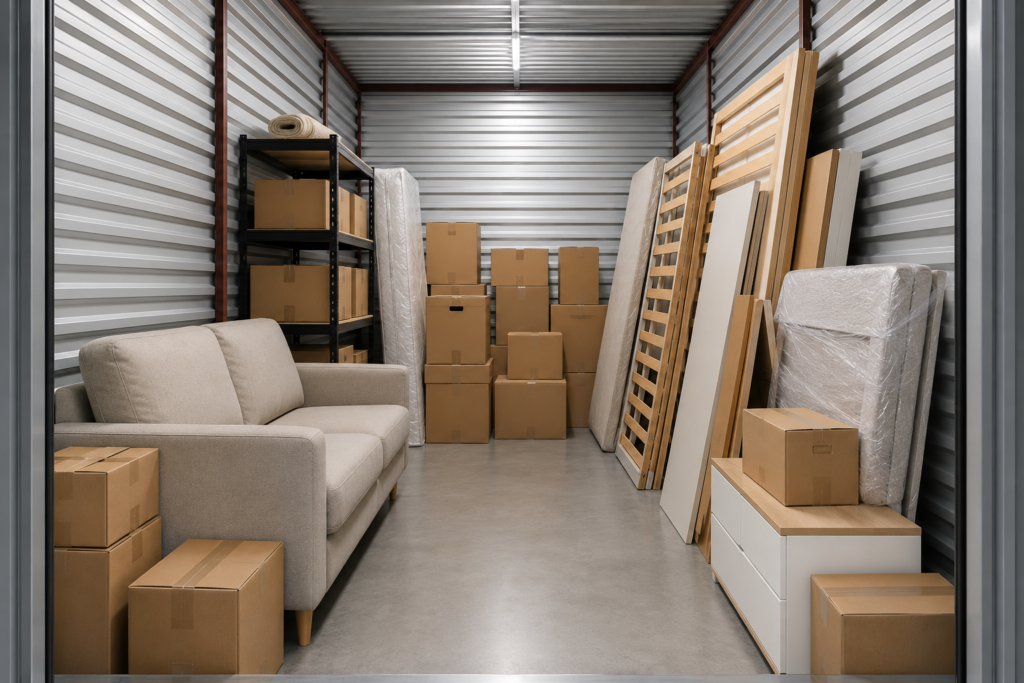
This way, a “huge wardrobe” takes up little more space than a few boards and shelves leaning next to each other.
Use Uniform, Closed Boxes
Bags of different sizes and half‑empty boxes carry a lot of air. Using uniform, stackable boxes makes it much easier to pack efficiently.
Try to:
-
use more small, sturdy boxes instead of a few giant, sagging bags
-
close all box lids so you can stack them safely
-
keep the heavy boxes at the bottom and the lighter ones on top
Neatly arranged boxes let you build a stable “wall” that uses both floor space and height to the maximum.
Use the Full Height of the Unit
A storage unit is not just floor area – it’s volume. If you only think at floor level, it’s easy to feel like you “need a few more square metres”. In reality, you often simply haven’t looked up.
Practical tips:
-
stack boxes along the walls, with the sturdiest ones at the bottom
-
if you have many smaller items, consider using shelving
-
store longer items (skis, ladders, boards) standing up, not lying down
If you follow these principles, you’ll often find that what you first guessed would need 6–7 m² actually fits comfortably into 3–4 m².
When Is a Larger Storage Unit Really the Better Choice?
It’s important to be clear: the goal isn’t always to choose the smallest possible unit. Sometimes a larger size genuinely gives you more comfort, time and flexibility – which can be worth the extra cost.
When You Have Many Large, Non‑Disassemblable Pieces
Some furniture is difficult or risky to take apart. For example:
-
antique, heavy wardrobes
-
pianos and other large instruments
-
massive corner sofas that don’t come apart
-
any item that could be damaged by disassembly
In these cases, you need to leave room around them and avoid squeezing everything into a unit that’s obviously too small.
When You Need to Access the Unit Regularly
The size you need is very different if you won’t touch your things for six months compared to going in and out several times a week.
A larger unit can make sense if:
-
you store stock for an online shop or business
-
you frequently take boxes in and out
-
you want to be able to walk between boxes, not move everything every time you visit
Here, the “extra” square metres actually buy you time and convenience, which can be worth it.

When You Expect Your Belongings to Grow Over Time
Sometimes you know from the start that what you’re storing now is just the beginning. For example:
-
you’re starting a business and know your stock will grow
-
you’re planning a long renovation and more furniture will arrive later
-
you’re merging households and the contents of multiple homes will end up in one unit
In these cases, it can be smart to plan ahead a bit – but even then, you don’t need to go to extremes. Again, a short chat with a specialist can help you find a size that gives you room to grow without being wildly oversized.
Why You Shouldn’t Try to Guess the Size Alone
Choosing the right storage unit size sounds simple, but in reality it depends on lots of small details. That’s why our team spends so much time helping customers make this decision every day.
For You It’s an Occasional Situation – For Us It’s Daily Routine
You’ll probably only have to move a large amount of belongings into storage a few times in your life. For us, it’s our everyday work. We’ve seen:
-
packed‑to‑the‑ceiling apartments and minimalist studios
-
families with three kids moving temporarily
-
online shop owners managing hundreds of boxes
This experience means that after a few targeted questions we can give you a very accurate estimate of the size that’s “big enough, but not unnecessarily big”.
Questions We’ll Ask to Recommend the Right Size
When you ask us for help, we’ll usually want to know things like:
-
how many rooms does the flat or house have?
-
how many large items do you have that you won’t dismantle?
-
will you be visiting the unit regularly, or is it more of a “drop and forget” situation?
-
how long do you plan to rent the unit?
Based on your answers, we can recommend a size that is safe but still cost‑efficient.
Fill in the Form and We’ll Tell You the Ideal Size – With No Obligation
You don’t need to walk around with a tape measure or spend hours calculating volumes. Just fill in our short online form in a few clicks and let our team do the thinking for you.
What Happens When You Submit the Form?
-
We ask you a few simple questions about your home, your furniture and your plans.
-
Based on your answers, we calculate which unit size we recommend.
-
We send you an estimate of the monthly price and your options.
-
If you like the offer, we help you book a unit – if not, there’s absolutely no obligation.
Our goal is to help you avoid the most common mistake: paying every month for a storage unit that’s bigger than you actually need. This way you know your belongings are safe and will fit comfortably – and you only pay for the space you really use.
Don’t Guess – Ask Instead
If you’re unsure, just ask. Tell us roughly how much you have, what type of items you’re storing and for how long, and we’ll help you find the ideal storage unit size. A quick form submission today could save you months of unnecessary costs.
Frequently Asked Questions About Choosing a Storage Unit Size
What if everything still doesn’t fit in?
You’re not stuck. If it turns out you need a bit more space, we can help you move into a larger unit. If you’re honest with us from the start about how much you have, we can minimise the chances of having to change sizes later.
Can I move to a larger unit later?
Yes. If your belongings grow over time or you realise you’d prefer a different layout, we’ll work with you to find a larger unit and support you through the move so it’s as easy as possible.
How do you calculate which size to recommend?
We look at the size of your home, the number of larger furniture pieces, how many boxes you expect, whether you plan to access the unit regularly and how long you’ll store your things. From these, we can estimate very accurately which unit size will be right for you.
When is it better to choose a larger unit?
When you have many large, non‑disassemblable pieces, when you need to walk between your boxes regularly, or when you know your belongings will keep growing during the rental period. In these cases the extra space buys you convenience and time.
What can I do to make a smaller unit work?
Good packing is the key: disassemble what you safely can, use strong, uniform boxes, and make full use of the height of the unit. If you’re not sure how to do this, our team is happy to give you practical packing tips as well.